
Tiles have gotten bigger. A lot bigger. What used to be a standard 2×2 foot vitrified slab is now routinely sold at 4×8 feet, sometimes larger. They look incredible once laid. The problem is what’s happening underneath them, where almost nobody’s looking.
If you’re searching for the best tile adhesive manufacturer in India right now, you’ve probably noticed every brand makes roughly the same claim. Here’s a scenario that plays out more often than it should: a homeowner spends real money on premium large format vitrified tiles, the floor looks flawless for the photos, and eight months later a corner lifts near the balcony door. Nine times out of ten, it’s not a bad batch of tiles. It’s an adhesive that was never built to hold something this big and this dense in place.
Why Vitrified Tiles are a Different Animal
Vitrified tiles absorb almost no water — often less than 0.5%. That does appear to be a good feature, and it definitely is, but it is also indicative of a regular cement sand mixture having nothing to adhere to. What you need here is an adhesive that can form a chemical bond with a hard glassy surface and not one that just needs to soak in. And that is precisely where the difference between an authentic vitrified tile adhesive manufacturer in India and any other company just repackaging the basic formula lies.
The second problem pertains to the issue of the size of the tile. An adhesive without real flexibility cracks under that movement well before the tile itself would. This is why it pays to buy from an established large format tile adhesive manufacturer in India who actually tests for slabs this size, rather than a small operation scaling up a residential-grade mix.
So what should "best" actually mean to you?
What you want to check is open time — how long you’ve got to position a heavy slab before the adhesive starts grabbing — and slip resistance, especially on a wall. Flexibility matters more than people think, and so does consistency of coverage.
Ceramic tiles, for what it’s worth, are more forgiving — they’re more porous, so a decent adhesive usually performs fine. But “more forgiving” doesn’t mean it doesn’t matter. A dependable ceramic tile adhesive supplier in India will still account for wall versus floor application and grout joint width, because both change how the adhesive behaves once it cures.
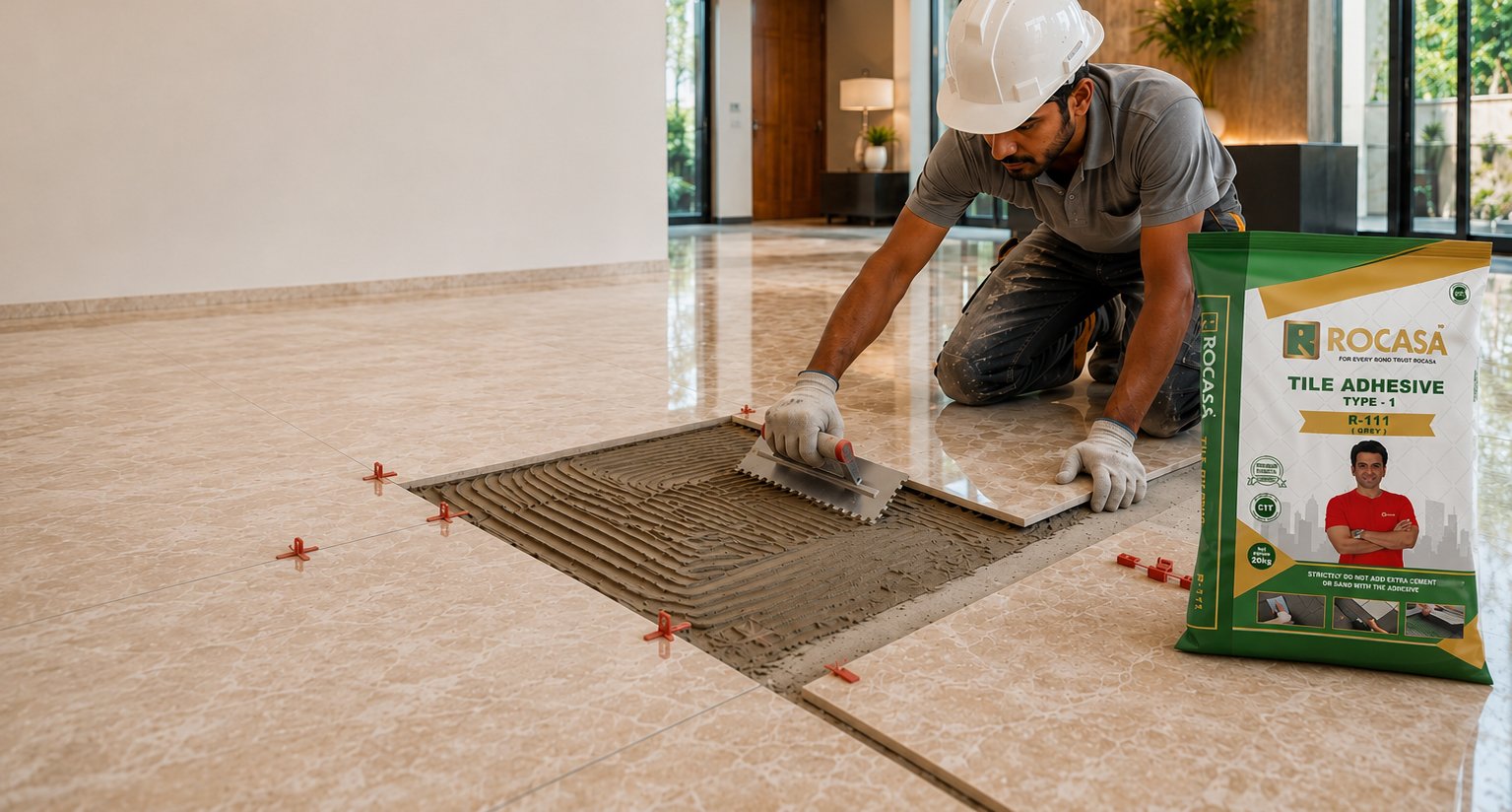
Where Rocasa comes in
Rocasa is the tile adhesive and construction chemicals brand under Kimps Industries LLP, built on more than 25 years in the tile and construction business. The range — R-111, R-333, R-555, R-777, R-999, and R-40 — was put together specifically around the gap between what large format and vitrified tiling actually demands and what a generic adhesive can deliver.
If your next job involves vitrified or large format tiles, it’s worth a call to the Rocasa team before you commit to a grade.
Before you place the order, run through this: check the tile’s water absorption rating, match open time to tile size, confirm floor-only versus floor-and-wall rating, and ask for the technical datasheet instead of assuming price equals performance.
Reach Rocasa at care@rocasa.in or +91 7517585285, or look through the full range at rocasa.in.
FAQ's
No. Vitrified tiles have very low water absorption, which means a standard cement-sand mortar or basic adhesive won’t form a proper bond. You specifically need a polymer-modified adhesive designed for low-porosity surfaces. Using the wrong one is the most common reason tiles lift or develop hollow spots within months of installation.
Three things matter most — longer open time so you can position a heavy slab without the adhesive grabbing too fast, good slip resistance so the tile doesn’t shift or slide during setting, and enough flexibility to handle minor structural movement without cracking. A quality large format tile adhesive manufacturer in India will list all three on the technical datasheet, not just tensile strength.
Yes, and it’s significant. Ceramic tiles are porous, so a mid-range adhesive bonds well by keying into the surface. Vitrified tiles need a chemically bonding formula since there’s no porosity to work with. Using ceramic-rated adhesive on vitrified tiles is one of the most common installation mistakes on Indian construction sites.
Rocasa’s R-777 and R-999 grades are specifically suited to vitrified and large format tile applications — for both floor and wall use. For exact grade recommendations based on your tile size and substrate, it’s best to contact the team directly at care@rocasa.in or +91 7517585285.
Yes. Larger tiles need fuller coverage underneath to avoid hollow spots, which typically means more adhesive per square foot than a standard-size tile job, along with a larger notch trowel size.